

The full bill has line items nobody budgets for. Ask a family what a season cost and they will name the application fees. Ask for the receipts and a second, quieter bill appears: score sends, credential evaluations, attestation, courier, translations. Here is the honest accounting for a ten-school season, and then the part of the market where the biggest line item is zero.
The full accounting
- Application fees, 10 schools: $430 to $800
- GRE score sends beyond the four free reports: $30 each
- TOEFL score sends beyond the free reports: about $20 each
- WES credential evaluation: $200 or more
- Transcript attestation and courier: $50 to $150
- Translations: $20 to $50 per page
Add the lines honestly and a ten-school season lands somewhere between $800 and $1,400 for a graduate applicant who needs the evaluation and the score sends, before a single campus visit. Undergraduate seasons run lighter on tests and evaluations, heavier on the number of schools. Either way, the fees themselves are only part of the bill, which is why cutting them takes two moves, not one.
Two families can apply to the same ten schools and end the season $600 apart, and the difference is never the listed fees, which are identical for both. It is the second bill: the sends, evaluations, and rush charges that one family scheduled and the other improvised. That is why the accounting below splits the season into the two bills. You negotiate with the first bill by choosing schools. You negotiate with the second by choosing when and how carefully you send things.
Where it is wasted
- Sending official scores to schools that accept self-reported scores at the application stage.
- WES evaluations for schools that do their own credential review.
- Rush courier for documents the portal accepts as uploads.
- Applying to 15 schools when 8 to 10 well-chosen ones perform better.
Most families cut 30 percent off the total with one careful hour of auditing these lines. But the deepest cut is not in the audit. It is in the list itself.
Run the arithmetic on the quiet lines and the audit stops looking optional. Ten schools with GRE sends beyond the free reports can mean six paid sends at $30, another $180. A WES evaluation at $200 or more costs more than three median application fees combined. Translations at $20 to $50 a page turn a long transcript into a real bill. None of these lines appears on any university's fee page, which is precisely why families underestimate the season by half when they plan it. The fees are the visible half of the cost. The audit exists for the invisible half.
The zero end of the market
Our Budget Builder database tracks 139 program entries, 135 with a recorded fee. Forty-four of them charge no application fee at all:
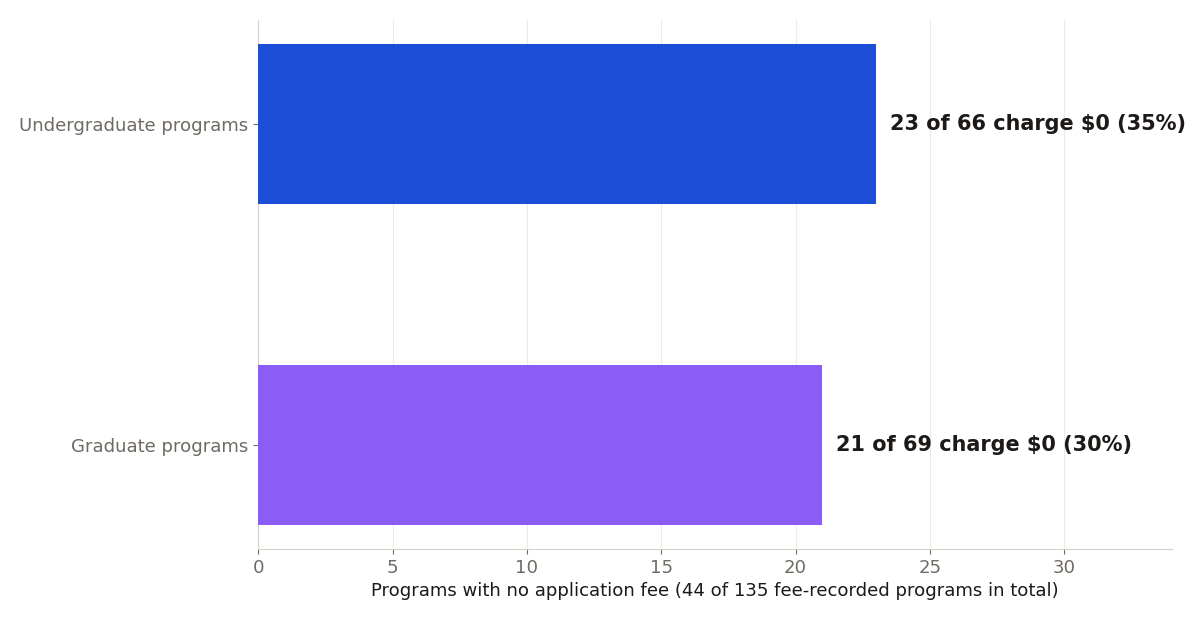
The split is even across levels: 23 of 66 undergraduate programs (35 percent) and 21 of 69 fee-recorded graduate programs (30 percent). These are program types and application systems rather than a handful of famous names, which is exactly why they get missed: nobody markets them to you. One honest wrinkle for international applicants: free is sometimes domestic-only. Of the 86 entries that record a separate international fee, 15 charge international applicants more, and 12 programs that charge domestic applicants nothing ask international applicants for $70 to $116. Check the international column before you count a program as free.
One more property of the zero end is worth knowing: 40 of the 44 zero-fee programs still list a waiver or exemption route in the data. That sounds redundant until you read it the other way. For many of these programs, free is not a blanket policy. It is an exemption with conditions attached, by applicant type, residency, or application round, and the route has to be claimed correctly to apply. Zero on the chart means zero for the applicants who follow the route. The route is part of the price, so read it before you budget around it.
Audit first, then rebuild the list
The order of operations matters. Audit the season you are planning with the free Application Budget Builder, which prices each program and flags its waiver route from the same data behind the chart. Cut the wasted lines. Then rebuild the list with two or three zero-fee programs you would genuinely attend, and watch the biggest line item shrink before a single waiver is requested. Our application fees comparison walks the full fee landscape, and the UCAS guide covers the UK system, where one fee covers up to five choices. Sources: Common App